The thriller motage above demonstrates the type of images used in a thirller and what comes to mind when discussing thrillers. The montage includes some of the ideas for our own thriller.
Sunday, 28 November 2010

Tuesday, 23 November 2010
Auter
Auter refers to the term of author and creator and the idea that some film directors impose a personal vision on their films. It's argued that Hitchcick stamped a number of creative features on his films including;

- very high angles shots
- exaggerating lighting effects
- precise editing
- Characters who are trapped or imprisoned
- exaggerated point of view
- creative use of sound (diegetic/non-diegetic)
- Misleading relationships
- Cameo appearances of Hitchcock
Voyeur; refers to watching something we are not supposed to be watching, also known as voyeuristic viewing.
Another known auter is Steven Speilberg.
He is a director with a clear, individual style. Some of his trademark techniques include ordinary people confronted by extraordinary situations such as;
He is a director with a clear, individual style. Some of his trademark techniques include ordinary people confronted by extraordinary situations such as;
- Jaws
- E.T.
- Schindlers list
- Close encounters of the third kind
Wednesday, 17 November 2010
Analysis of past students work
Today in class we watched past students openings to their thrillers and had to discuss their ideas and decide on what we would grade them. also we had to decide on what we would mark them out of ten for their;
This is what i graded it;
Film 1
Idea - 9/10
Cinematography - 8/10
Sound/music - 9/10
Performance - 9/10
Grade - A
- Idea
- Cinematography
- Sound/Music
- Performance
Film 1
Idea - 9/10
Cinematography - 8/10
Sound/music - 9/10
Performance - 9/10
Grade - A
Sound within a flim
There are two main types of sound within a film; diegetic and non-diegetic.
Diegetic sound refers to sound within world of the text, for example the dialogue within the flim would be classed as diegetic.
Diegetic sound however, can also be broken down into on-screen and off-screen sound;
On-screen sound is sound that we can see being made on the film such as a person walking, we can see and hear their footsteps.
Off-screen sound is when the sound is being made from another place within the world of the text, we can not see the source of the sound but however it is still being made in the world of the text, for example footsteps from a protagonist in the distance which we can't see.
Non-diegetic is the sound that is not the world of the text, this could be example narration or background music.
Diegetic sound refers to sound within world of the text, for example the dialogue within the flim would be classed as diegetic.
Diegetic sound however, can also be broken down into on-screen and off-screen sound;
On-screen sound is sound that we can see being made on the film such as a person walking, we can see and hear their footsteps.
Off-screen sound is when the sound is being made from another place within the world of the text, we can not see the source of the sound but however it is still being made in the world of the text, for example footsteps from a protagonist in the distance which we can't see.
Non-diegetic is the sound that is not the world of the text, this could be example narration or background music.
Friday, 12 November 2010
codes and conventions of a thriller
There are 7 different types of codes and conventions including; lighting, setting, editing, cinematography, characters, diegetic and non-diegetic.
lighting;
Setting;
lighting;
- often at night/dark/eerie
- low level lighting
- shadows/limited view of a character
- dim colours, also red
Setting;
- isolated/deserted/exotic - desert, ranch or old warehouse
- confined locations; lift, phone booth etc
- Generic feature of a thriller is entrapment
Editing;
- Quick cuts/ fast pace; enhance anxiety and confusion
- Jump cuts; shows erratic tension
- Match cuts; links two ideas
Cinematography;
- Camera angles low/high; plays with and highlights the roles of authority/ power within the film
- Point of view shot; demonstrates what the character is seeing or feeling
- Establishing shot; setting the scene
- Close ups; highlights sense of anxiety and tension
- Frantic camera movements; portrays tense environment
Characters;
- Criminals, stalkers, assassins, down-on-their-luck losers, dark pasts, innocent victims, psychotic people, terrorists, private eyes, drifters
- Ambiguous roles; are they good/bad?
Diegetic;
- Creaky doors, wind, tap dripping, foot steps; sounds that alert the audience that something is about to happen
- Silence, provoking
- Heavy breathing
- whispering
Non-diegetic;
- High pitched music; heightens suspense
- Ambience music; Helps to create the correct atmosphere
- Fast pace music; essential for action scenes
Monday, 8 November 2010
Film opening analysis of history of violence
 During the first five minutes of this film three murders were shown, however the men that seem to have carried out these killings seemed calm and peaceful. This made the opening of this thriller effective as the characters seem emotionless as if they could kill many people and not feel any remorse. This could make it rather thrilling as you never know when they are going to kill someone next due to the fact that they seem to not be effected by the consequences of their actions.
There isn't much sound in the beginning of this film, this makes the film unique as there is no soundtrack which would normally be used to create suspense, instead the start of this film creates an eerie atmosphere instead. The lack of sound is effective as the first main bit of sound you hear is a small girl scream, making the audience jump. Moreover, the beginning of this film creates a tense atmosphere very well by using enigmas and suspense.
Saturday, 6 November 2010
film opening analysis of Momento
During this lesson we viewed the first 5-10 minutes of four different films; momento, children of men, a history of violence and collateral. We then wrote notes on the extract, what makes it a thriller and what makes the audience want to carry on watching.

The first film we looked at was Momento. Throughout the beginning of Momento the lengh and speed of the edits was changed very effectively, starting off slow, thenn speeding up and finally ending slow again. The dark shadows made the scene look as though it was a bad place furthermore, the fact that it was a crime scene also reflects this too. This is because it is explaining the story backwards which is not the normsal route taken for the opening to a film. This is effective as it keeps the audience watching as they want to know more about what is happening, why and what has previously happened.
Throughout this extract there is a great use of an enigma, this is as the man in the scene has killed a man, which makes the audience want to seek to solve how this has happened.
Thursday, 4 November 2010
Film opening analysis of Children of Men
The second film we watched was Children of men.
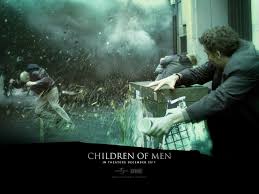
During the opening credite of this film a 'breaking news' report is being read out stating that the youngest person in the world, being of age 18, has been killed. This is a very dramatic and attention catching opening as you the veiwer then believes to question how and why is that the youngest person in the world at the age of 18, why has no one had a baby over the past 18 years? Also, an explosion takes place at the start of the film this also catches the veiwers eye and gets them wondering why was there an explosion, whats going on? Finally, the society seems very corrupt, there is a high pitched noise and the colour seems very dull. This makes the atmosphere seem as though it is very sad and damaged.
Monday, 1 November 2010
No Country For Old Men - Opening
 No Country For Old Men is a story of an ordinary man to whom chance delivers a fortune that is not his.
The start of no country for old men is very effective in creating suspense. Quite a few people die in the first few minutes of the film, this makes you want to carry on watching as you want to find out who this character is and why he is killing all these people. Also the fact that the film is set in an isolated place causes a lot of tension and makes it seem eary as it is quiet and windy. The murderer in this film seems very sinsister and ominous as he doesn't give anything away. He acts calm when questioned by the man he pulls over at the side of the road, and just repeats for him to get out of the car. It's as if he is rehearsed, he acts as though he has no emotions, his murders are passionless.
The sound at the start of No country for old men is non-diagetic, it's as if the sheriff is speaking directly to us. This hapens a the start and the end of the film. This is effective as it is showing that he must be playing a great role in the film to be a main part at the start and end. The opening can be broken down into;
C - costume
L - lighting
A - actors
M - make up
P - props
S - setting
Costume; Villain is wearing all dark, dull clothes. Suggests darkness and perhaps evil. Shows deffinate signs of villain
lighting; Nothing is given away about the antagonist, shadows cover his face.
Actors; Only the villain is shown in the first sequences to the thriller, others are shown but we do not know who they are.
Make up; pale make up is used on the face and dark around his eyes to emphasise that Anton Chigurh is the villain.
Props; Oxygen tank is used for the murders.
Setting; Isolated dessert, eerie as there is no one near to help in bad situations.
Analysis of Anton Chigurh;
Costume;
- dark, black clothes
- nothing is shown about the character
- suggests his emotionless and perhaps evil
- suggests his a villain, wears mysterious clothes
Speech, language and tone;
- minimal amount of speech, simplistic, calm and monotone
- uses nicities to get his way
- talks with questions, he is in control
Manerisms, actions and responses;
- not many actions
- calm but argumantative
- no remorse or compassion
- emotionless
- intimidating
- little physical contact with others
- symplistic
Representation in film;
- one dimentional character
- outcast
- doesn't have a background
- morally complex
- stands for death, evil?
Subscribe to:
Posts (Atom)